Fleet PCN management is the process of capturing, checking, actioning, appealing, paying, recharging, reporting, and preventing Penalty Charge Notices and parking-related notices across a fleet.
For UK fleet operators, the aim is simple: never miss a deadline, never pay blindly, and never lose visibility of why PCNs are happening. A PCN can relate to parking, but it can also cover certain traffic contraventions such as bus lanes, moving traffic restrictions, London congestion charging, low emission zones, or Dart Charge issues. GOV.UK notes that PCNs are usually payable within 28 days and, in some cases, reduced if paid within 14 days.
Good fleet PCN management protects margin, reduces admin pressure, supports compliance, and gives managers the data they need to stop repeat offenses.
What is fleet PCN management
Fleet PCN management covers the full lifecycle of a notice, from the moment it arrives to the moment it is closed. That includes council-issued Penalty Charge Notices, Transport for London notices, private parking charge notices, parking control issues, and other enforcement notices that may reach the registered keeper, lease company, hire company, or operator.
For a fleet, one PCN is rarely just one PCN. It can trigger driver checks, route reviews, customer-site disputes, payroll deductions, supplier queries, appeal evidence gathering, and management reporting. Without a clear system, PCNs quickly become a spreadsheet problem, then a compliance problem, then a cost problem.
Why fleet PCN management matters
The biggest risk is not always the charge itself. It is the process around the charge.
If a notice is missed, the cost can increase. GOV.UK states that if a PCN is not paid within 28 days, a charge certificate may be issued, increasing the original fine by 50%.
For operators running vans, HGVs, pool cars, hire vehicles, or grey fleet, the challenge is even bigger. Notices may arrive at different locations, under different names, and with different evidence requirements. A driver may have left the business. A vehicle may have been on hire. A depot may know the context, but head office may receive the notice.
That is why fleet PCN management should be treated as a controlled workflow, not an admin task.
Fleet PCN Management for Parking Fines
Parking fines can look like small, isolated costs. But across a busy fleet, they quickly become a repeat admin problem.
For UK fleet operators, parking PCNs can affect:
- Driver productivity
- Admin workload
- Operating costs
- Customer delivery schedules
- Compliance records
- Recharge and payroll processes
- Reporting accuracy
A single parking fine may be easy to handle. The real issue starts when notices arrive from different councils, private parking control companies, lease providers, depots, and email inboxes. Without a clear fleet PCN management workflow, deadlines are easy to miss and costs can increase unnecessarily.
Why parking PCNs are easy to miss
Parking fines often do not arrive in a neat, predictable way.
They may come through:
- Post sent to head office
- Emails from a parking operator
- Lease company notifications
- Depot handovers
- Driver-submitted notices
- Private parking control portals
- Customer-site parking enforcement
This makes parking PCNs especially easy to lose track of when vehicles are shared, leased, hired, or used across multiple sites.
By the time the right person sees the notice, the reduced payment window may already be close to expiring. That is why each parking fine should be logged as soon as it enters the business.
What to record for each parking fine
Every parking fine should have a clear record. This gives fleet managers visibility, supports appeals, and creates an audit trail if the charge is disputed later.
At a minimum, record:
- PCN reference number
- Vehicle registration
- Driver or vehicle user
- Depot, team, or cost center
- Issuer name
- Notice type
- Contravention date and time
- Location
- Amount due
- Discount deadline
- Final payment deadline
- Current status
- Appeal evidence
- Final outcome
This is where a dedicated fleet pcn management software can make a real difference. Instead of relying on spreadsheets and inbox searches, the business has one place to track every parking fine from receipt to resolution.
What to check before paying or appealing
Before making a decision, check the details carefully.
Ask:
- Is the vehicle registration correct?
- Does the date and time match the vehicle’s records?
- Was the vehicle actually at that location?
- Who had the vehicle at the time?
- Was the driver loading, delivering, collecting, or attending a job?
- Was there a valid permit or payment session?
- Was the signage clear?
- Is there ANPR or camera evidence?
- What is the discount deadline?
- What is the appeal deadline?
These checks help the fleet team avoid paying incorrect notices and avoid wasting time appealing charges that are clearly valid.
When to pay a parking PCN
Paying may be the most practical option when:
- The vehicle details are correct
- The driver confirms the contravention
- There is no strong evidence for appeal
- The signage and location are clear
- The reduced payment deadline is approaching
- The cost of further admin outweighs the likely benefit
The aim is not to appeal every parking fine. Sometimes the best decision is to close the notice quickly, record the reason, and recharge the cost where your company policy allows.
When to appeal a parking PCN
An appeal may be worth considering when there is clear evidence that the fine is wrong or unfair.
Useful appeal evidence may include:
- Proof of parking payment
- Valid permit evidence
- Loading or delivery notes
- Job sheets
- Customer-site instructions
- Photos of unclear signage
- Evidence of incorrect vehicle details
- ANPR entry or exit errors
- Proof that the vehicle was elsewhere
- Driver statement or route record
A calm, evidence-led appeal is usually stronger than a long explanation. Keep it factual. Attach the right documents. Record the appeal date, response deadline, and final decision.
The real goal is fewer repeat parking fines
Good fleet PCN management is not just about paying or appealing. It should help the business understand why parking fines keep happening.
Look for patterns such as:
- Repeat locations
- Repeat drivers
- Problem customer sites
- Confusing loading bays
- Expired permits
- Missed parking payments
- Poor route instructions
- High-risk parking control areas
Once those patterns are visible, fleet managers can take practical action. That might mean updating driver guidance, improving customer-site notes, adding permit reminders, changing delivery instructions, or flagging high-risk locations before drivers arrive.
With a clear process, parking fines become easier to manage, easier to report, and easier to prevent. That is the value of fleet pcn management: fewer missed deadlines, better decisions, cleaner records, and more control over fleet costs.

Common Fleet Fines Businesses Need to Track
Fleet fines do not all come from the same place. Some are issued by councils, some by private parking operators, some by transport authorities, and others by enforcement bodies.
For fleet managers, the key is to record every fine in a consistent way, even when the notice type is different. This helps the business avoid missed deadlines, check liability, recover costs where appropriate, and spot repeat issues before they become expensive.
Parking PCNs
Parking PCNs are one of the most common fines for business fleets.
They can happen when a vehicle is:
- Parked in a restricted bay
- Parked without a valid permit
- Overstaying paid parking
- Stopped in a loading bay without clear evidence of loading
- Parked on private land monitored by parking control
- Captured by ANPR at a customer site, retail park, hospital, airport, or depot
For fleets, these notices are easy to miss because they may be sent to head office, a lease provider, or a depot rather than the driver. Each parking PCN should be checked against vehicle records, driver allocation, job notes, permits, and payment evidence before deciding whether to pay or appeal.
Bus Lane PCNs
Bus lane PCNs can quickly become a repeat issue for delivery, service, and urban fleets.
They often happen because of:
- Unclear road layouts
- Restricted operating hours
- Drivers following sat nav routes
- Last-minute lane changes
- City-center delivery pressure
- Unfamiliar local restrictions
These fines should be reviewed by location and route. If the same bus lane keeps appearing in reports, the issue may not be driver behaviour alone. It may point to a route planning, training, or customer delivery instruction problem.
Congestion Charge Penalties
Congestion charge penalties usually happen when a vehicle enters a charging zone without the correct payment, exemption, or account setup.
Fleet teams should track:
- Vehicle registration
- Zone entry date
- Payment status
- Account coverage
- Driver or department responsible
- Whether the vehicle should have been exempt or pre-registered
These penalties are often preventable with better account management, vehicle list updates, and reminders for drivers who regularly operate in chargeable areas.
ULEZ or Clean Air Zone Penalties
ULEZ and Clean Air Zone penalties can affect fleets operating in cities with emissions-based charging schemes.
They may occur when:
- A non-compliant vehicle enters a zone
- A compliant vehicle is not correctly registered
- A payment is missed
- Vehicle records are outdated
- A temporary or hire vehicle is used without checking zone requirements
For fleet operators, this is where accurate vehicle data matters. Your system should show which vehicles are compliant, which zones they enter, and whether payments or exemptions are in place.
Toll Penalties
Toll penalties can be issued when a crossing, bridge, tunnel, or road user charge is not paid correctly.
Common causes include:
- Missed payment deadlines
- Incorrect vehicle registration
- Hire or replacement vehicles not added to an account
- Drivers assuming payment is automatic
- Account balance or direct debit issues
- Poor handover between fleet, finance, and operations teams
Fleet managers should make sure toll accounts are regularly checked and vehicle lists are kept up to date. This is especially important for high-mileage fleets and vehicles that cross chargeable routes often.
Fixed Penalty Notices
Fixed Penalty Notices are different from parking PCNs and should be handled carefully.
They may relate to offences such as:
- Speeding
- Mobile phone use
- Vehicle defects
- Seatbelt offences
- Weight or loading issues
- Driving without correct documents
Because these notices can involve driver responsibility, licence points, or enforcement action, they should not be treated as routine admin. The business should record the notice, identify the driver, keep a clear audit trail, and follow the required response process within the deadline.
Late Payment Charges
Late payment charges are usually a sign that the PCN process is not working as well as it should.
They can happen when:
- Notices are sent to the wrong address
- Lease company notifications are delayed
- Internal ownership is unclear
- Nobody tracks discount deadlines
- Appeals are submitted late
- Payment approvals take too long
- Spreadsheets are not updated
These charges are often avoidable. A good fleet PCN management process should flag deadlines early, assign responsibility, and give managers visibility before costs increase.
What this means for fleet managers
The fine type may change, but the process should stay consistent.
For every fleet fine, record:
- Notice reference number
- Vehicle registration
- Driver or vehicle user
- Issuer
- Fine type
- Date and time
- Location or zone
- Amount due
- Discount deadline
- Final deadline
- Evidence required
- Action taken
- Final outcome
The goal is not just to close each notice. It is to understand where fleet fines are coming from, why they keep happening, and what can be done to prevent them.
With a clear fleet PCN management process, businesses can reduce admin, avoid unnecessary late payment charges, support fair driver decisions, and keep better control over fleet operating costs.
PCN vs Fixed Penalty Notice: What Fleet Managers Should Know
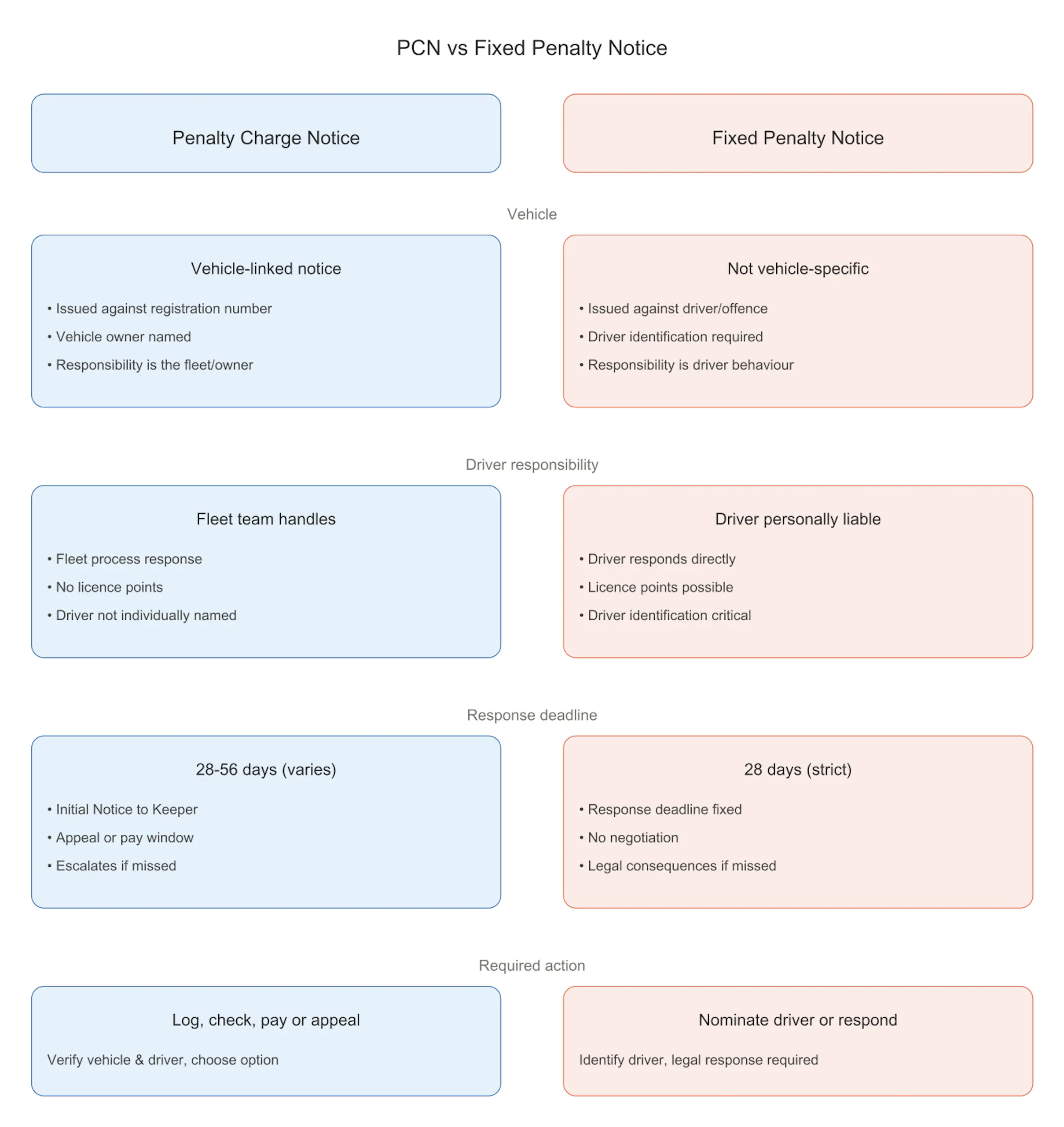
PCNs and Fixed Penalty Notices can look similar, but they are not the same. For fleet managers, the difference matters because the process, risk, and responsibility can change depending on the notice type.
A PCN usually relates to parking, bus lanes, congestion charging, moving traffic restrictions, or similar civil enforcement issues.
A Fixed Penalty Notice, often called an FPN, is usually linked to a road traffic offence.
The simple difference
For fleet teams, the easiest way to think about it is:
- PCN: Usually linked to the vehicle, location, restriction, parking control, or charge zone.
- FPN: Usually linked to driver behaviour or a motoring offence.
- PCN risk: Missed deadlines, increased charges, poor reporting, or unnecessary payment.
- FPN risk: Driver identification, license points, legal response deadlines, and possible enforcement action.
What to check first
When a notice arrives, do not treat it as routine admin until it has been classified correctly.
Check:
- Is it a PCN, parking charge notice, or Fixed Penalty Notice?
- Who issued it?
- Is the vehicle registration correct?
- What date and time did the incident happen?
- Who had the vehicle at the time?
- Is there a payment, appeal, or driver nomination deadline?
- Could the notice affect the driver’s licence?
- Is there evidence to support an appeal or challenge?
Why this matters for fleets
A PCN may be handled through your normal fleet PCN management process: log it, check the vehicle, confirm the driver, review the evidence, then pay, appeal, recharge, or report.
An FPN needs more care. It may involve the driver personally, especially where penalty points or an offence response is required. That means the fleet team should keep a clear audit trail and make sure the right person responds within the deadline.
Best practice for fleet managers
Use one central process to record all notices, but separate them by type.
Track:
- PCNs
- Private parking charges
- Bus lane PCNs
- Congestion charge penalties
- ULEZ or Clean Air Zone penalties
- Toll penalties
- Fixed Penalty Notices
- Late payment charges
The goal is simple: know what the notice is, who is responsible, what the deadline is, and what action is needed next.
Good fleet PCN management is not just about paying fines. It is about making the right decision quickly, protecting the business, and keeping clear records when driver responsibility or compliance is involved.

Fleet PCN management checklist
1. Capture every notice in one place
Centralize post, email, portals, lease-company notifications, and depot submissions. Record the PCN number, vehicle registration, issuer, notice type, contravention date, received date, deadline, amount, discount date, evidence, and owner.
2. Match the PCN to the vehicle and driver
Use fleet management software, telematics, job schedules, driver logs, hire records, and depot allocation sheets to confirm who had the vehicle. This is especially important where vehicles are shared, swapped, leased, or used out of hours.
3. Classify the notice correctly
Do not treat all notices the same. A council PCN, a TfL notice, and a private parking charge can have different rules, timelines, appeal routes, and evidence requirements.
4. Decide: pay, appeal, transfer, or recharge
Pay quickly where the notice is valid and the discount window matters. Appeal where there is strong evidence, such as unclear signage, incorrect VRM, valid permit, paid parking session, loading activity, exemption, or vehicle not present.
5. Keep an audit trail
Store all correspondence, evidence, appeal text, payment receipts, driver responses, approvals, and recharge decisions. This protects the business if the notice escalates, if a driver disputes a deduction, or if management asks for cost breakdowns.
6. Report on causes, not just costs
The best fleet pcn management reports show patterns. Which locations create the most PCNs? Which drivers need coaching? Which depots miss deadlines? Which routes create recurring parking control issues? Which customer sites need better loading instructions?
7. Prevent repeat PCNs
Prevention may include driver briefings, route notes, permit controls, site instructions, ANPR payment reminders, geofenced alerts, customer delivery-window changes, or clearer responsibility rules for fines and appeals.
The role of software in fleet PCN management
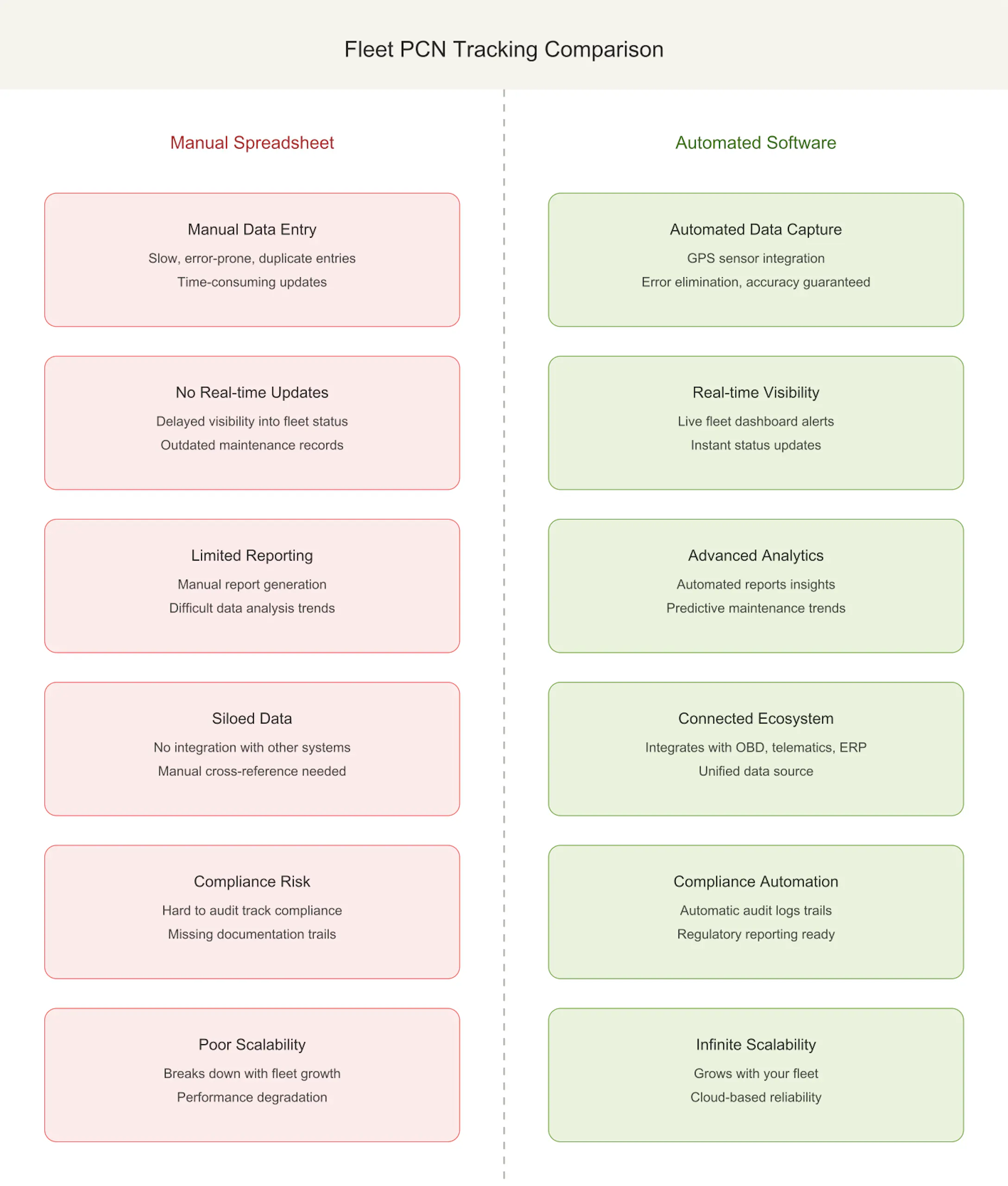
Manual PCN handling works for a small number of vehicles, but it becomes fragile as volume grows. The right fleet management software should reduce repetitive admin and make the process visible.
Look for software that can:
- Capture notices from email, upload, or portal entry.
- Flag payment and appeal deadlines.
- Match PCNs to vehicles, drivers, depots, or jobs.
- Store evidence and correspondence.
- Create approval workflows for pay, appeal, nominate, or recharge decisions.
- Generate appeal packs and management PCN reports.
- Track cost recovery from drivers, hirers, customers, or departments.
- Show repeat locations and repeat contravention types.
- Integrate with your fleet, HR, telematics, finance, or lease data.
A good system does not just help you pay faster. It helps you make better decisions.
Common mistakes UK Fleet operators should avoid
Paying every notice automatically: Fast payment may protect the discount, but it can hide incorrect notices, poor signage issues, customer-site problems, or valid appeal grounds.
Missing the first deadline: Even where you intend to appeal, late action limits your options and can increase cost.
Not separating council PCNs from private parking charges: Different issuers may use different processes and escalation routes.
Weak evidence collection: Appeals are harder when photos, delivery notes, permits, payment records, or driver statements are missing.
No clear driver policy: Drivers should know when they are liable, when the company will support an appeal, and what evidence they must provide.
No reporting loop: If the same supermarket, hospital, airport, loading bay, bus gate, or permit zone keeps generating charges, the issue is operational, not administrative.
Choosing the right fleet PCN management software
Choose software that fits how your fleet actually works. A courier fleet, utilities fleet, rental fleet, service fleet, and logistics operation all need slightly different workflows.
Before booking a demo, ask:
- Can it handle council, TfL, private parking, parking control, and lease-company notices?
- Can it track discount deadlines and appeal deadlines separately?
- Can it link notices to drivers, vehicles, depots, jobs, and cost centers?
- Can managers approve appeals or payments before action is taken?
- Can it support liability transfer, driver nomination, and recharging?
- Can it produce reports by location, driver, contravention, issuer, depot, and month?
- Can it integrate with our existing fleet management software or finance process?
- Is there a full audit trail for compliance and dispute handling?
Reduce PCN admin across your fleet
Fleet PCN management becomes easier when every notice has an owner, a deadline, a decision, and a record.
Book a demo to see how Snapmyfine helps fleet operators manage PCNs, appeals, deadlines, and reporting in one smoother workflow.
FAQs
What is fleet PCN management?
Fleet PCN management is the process of managing parking, traffic, and enforcement notices across company vehicles. It includes capture, driver matching, evidence review, appeals, payment, liability handling, recharge, reporting, and prevention.
Why is fleet PCN management important for UK operators?
It reduces missed deadlines, avoids unnecessary costs, improves compliance, and gives fleet managers visibility of recurring issues. It also helps operators make fair, evidence-based decisions before paying or appealing.
Can fleet management software manage PCNs?
Some fleet management software includes PCN workflows, but many systems only hold vehicle data. Operators with regular notices should look for dedicated fleet pcn management features such as deadline alerts, evidence storage, appeal tracking, recharge workflows, and reporting.
Should fleets appeal PCNs?
Fleets should appeal where there is clear supporting evidence. That may include valid parking payment, loading activity, incorrect vehicle details, unclear signage, exemption evidence, or proof that the vehicle was not responsible. Always check the issuer’s process and deadline.
How can fleets reduce PCNs?
The best prevention comes from reporting. Track PCNs by driver, site, route, issuer, and contravention type. Then use the data to improve driver briefings, permits, route planning, customer-site instructions, payment reminders, and parking control procedures.
How do businesses manage fleet parking fines?
Businesses manage fleet parking fines by using a clear process to record, review, action, and report every notice. The aim is to make sure no parking PCN is missed, paid late, or handled without checking the details first.
